
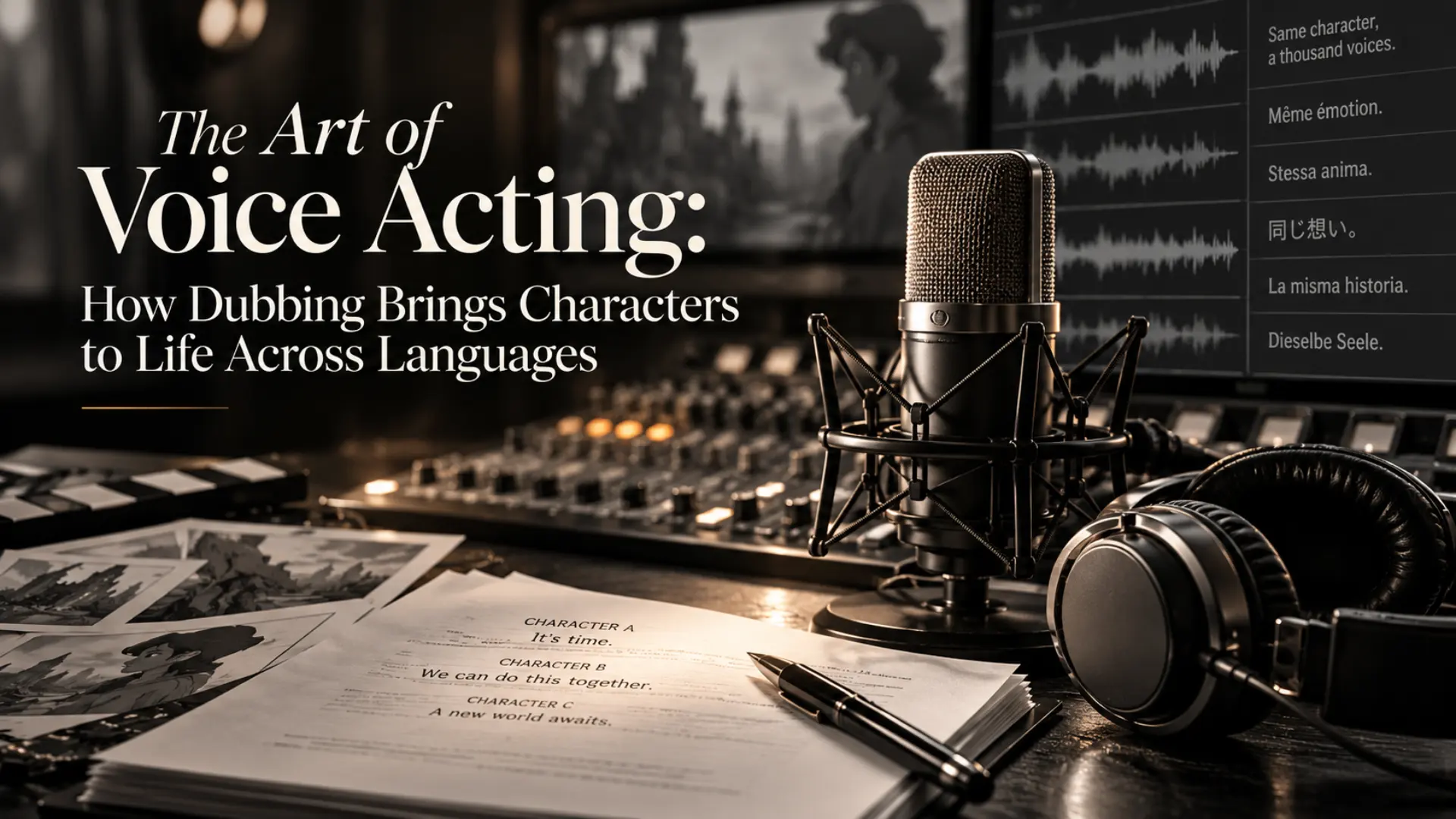
Voice acting is an important part of film, television, animation, and audio production. While actors appearing on screen communicate through facial expressions, physical movement, and spoken dialogue, voice performers must often communicate a character’s emotions primarily through sound. Their work involves pronunciation, rhythm, timing, vocal control, and interpretation.
One of the most recognizable applications of voice acting is dubbing, a process in which original dialogue is replaced with recorded dialogue in another language. Dubbing allows audiences to experience audiovisual productions without needing to read subtitles throughout the programme.
However, effective dubbing involves considerably more than translating words. It requires the coordination of language adaptation, performance, recording techniques, and sound production.
Understanding the Difference Between Voice Acting and Dubbing
Voice acting is a broad performance discipline that includes animation, advertising, audiobooks, video games, radio drama, and other recorded media. Performers use their voices to communicate information, establish personality, or portray fictional characters. Dubbing is a specific form of recorded performance in which new dialogue is synchronized with existing visual material. It is commonly associated with international film and television distribution, although it can also be used for other production purposes.
In a dubbed production, the original actor’s physical performance remains visible while another performer provides the dialogue heard by the audience. This arrangement creates particular challenges because the new voice must fit the established characterization and the pacing of the scene. A successful performance preserves the intended meaning of the dialogue while making the spoken language feel natural to the audience.
Why Translation Alone Is Not Enough
Translating dialogue for dubbing requires attention to both meaning and performance. Languages differ in word order, sentence length, idiomatic expressions, and grammatical structure. A sentence that sounds natural in one language may become awkward when translated word for word into another.
For example, a short expression of surprise may require more syllables in the target language. If the translated dialogue takes significantly longer to speak, it may not fit the visible movements or timing of the original scene. Dialogue adaptation addresses these problems by adjusting the wording while retaining the essential meaning, tone, and dramatic purpose.
Cultural context is another consideration. Humour, figures of speech, and conversational habits do not always transfer directly between languages. An appropriate adaptation must respect the original work while remaining understandable to its new audience. These decisions affect how voice actors approach their performances, because the adapted script becomes the foundation for the recorded dialogue.
How Voice Actors Create Believable Characters
A recognizable voice does not automatically create a convincing character. Voice acting depends on the performer’s ability to understand the character’s intentions, emotions, and relationship to the surrounding story. Several elements contribute to this process.
Vocal Tone and Emotional Expression
Vocal tone communicates emotion through the quality and delivery of sound. Fear, excitement, sadness, uncertainty, and confidence can influence pitch, intensity, breathing, and articulation. An effective performer chooses vocal details that fit the character rather than exaggerating every emotional moment.
A quiet line can communicate tension, while a change in speaking pace may indicate hesitation or urgency. These choices contribute to the audience’s understanding of the scene.
Timing, Rhythm, and Synchronization
Timing is especially important in dubbing because the dialogue must align with the visual performance. In live-action productions, performers may need to consider visible mouth movements as well as pauses, gestures, and reactions. Perfect correspondence between every sound and mouth shape is not always possible, particularly across different languages, but timing and plausibility remain essential.
Animation can present different synchronization requirements depending on whether voices are recorded before or after the visuals are produced. In both cases, performers work within technical and dramatic constraints. A line must be delivered at the correct moment without losing its emotional meaning.
Character Consistency
Long-form television series and recurring animated productions often require a character to maintain a recognizable vocal identity across multiple episodes.
Consistency involves more than repeating the same pitch or accent. It also includes habitual rhythms, emotional tendencies, articulation, and the overall manner of speaking.
At the same time, characters must remain capable of emotional development. A convincing performance allows a character’s voice to change naturally with the circumstances of the story.
The Relationship Between Singing and Voice Acting
Singing and voice acting are distinct disciplines, but they share several important technical foundations. Both require an understanding of breathing, articulation, phrasing, and vocal expression. Singers learn to organize sound through pitch, rhythm, and musical structure, while actors use many of the same physical mechanisms to communicate dialogue.
Classical singers also work with resonance, sustained tones, and breath management, which are important elements of vocal technique.
However, singing experience does not automatically replace dramatic training. A skilled voice actor must interpret intentions, respond convincingly to other characters, and adapt vocal technique to the requirements of a script.
Musical animation creates an especially interesting overlap between these disciplines. Some productions require characters to speak and sing, making the relationship between dramatic characterization and vocal performance particularly important. When dialogue and songs belong to the same character, the production must consider how the speaking and singing voices fit together.
The Role of Multilingual Skills in Vocal Performance
Multilingual voice work involves more than the ability to communicate in different languages. Each language has characteristic patterns of rhythm, stress, vowel production, and intonation. These patterns influence how dialogue sounds and how emotions are expressed.
A performer working across multiple languages must consider pronunciation and intelligibility while maintaining the intended characterization. Fluency can support natural dialogue delivery, but professional performance may still require preparation for regional accents, specialized terminology, or culturally specific expressions.
In dubbing, language adaptation and acting are closely connected. A technically accurate translation may sound unnatural if the actor cannot deliver it convincingly within the scene. For this reason, the collaboration between translators, dialogue adapters, directors, and performers is an important part of multilingual audiovisual production.
The Recording Studio and the Production Process
Voice performances are captured using recording equipment designed to reproduce spoken sound clearly.
Microphones, acoustic treatment, recording software, and monitoring systems all contribute to the technical quality of the finished material. Studio conditions help reduce unwanted environmental noise and provide a controlled environment for recording.
During dubbing sessions, performers generally work with visual references and prepared dialogue. Depending on the production method, the director may guide the actor’s delivery, pronunciation, emotional interpretation, and synchronization.
Individual lines or scenes may require multiple takes to achieve the intended result. Following recording, audio editors and sound mixers integrate the dialogue with music, sound effects, and other elements of the soundtrack. The objective is not simply to produce clean speech, but to make the dialogue sound integrated with the fictional environment.
Why Human Interpretation Remains Important
Digital recording tools can edit audio, adjust timing, and process sound, but the artistic value of a voice performance also depends on interpretation. Human speech contains subtle variations that communicate uncertainty, affection, irritation, sincerity, and many other emotional states. A pause before a response can be just as meaningful as the words that follow.
Voice actors use these variations deliberately, drawing on their understanding of the character and the circumstances of a scene. Technical tools support the production process, while the performance gives the dialogue its dramatic purpose. This distinction helps explain why voice acting is recognized as a creative discipline rather than merely a recording task.